You did not build a growth system. You built a set of assumptions. Now AI is running them at full speed.
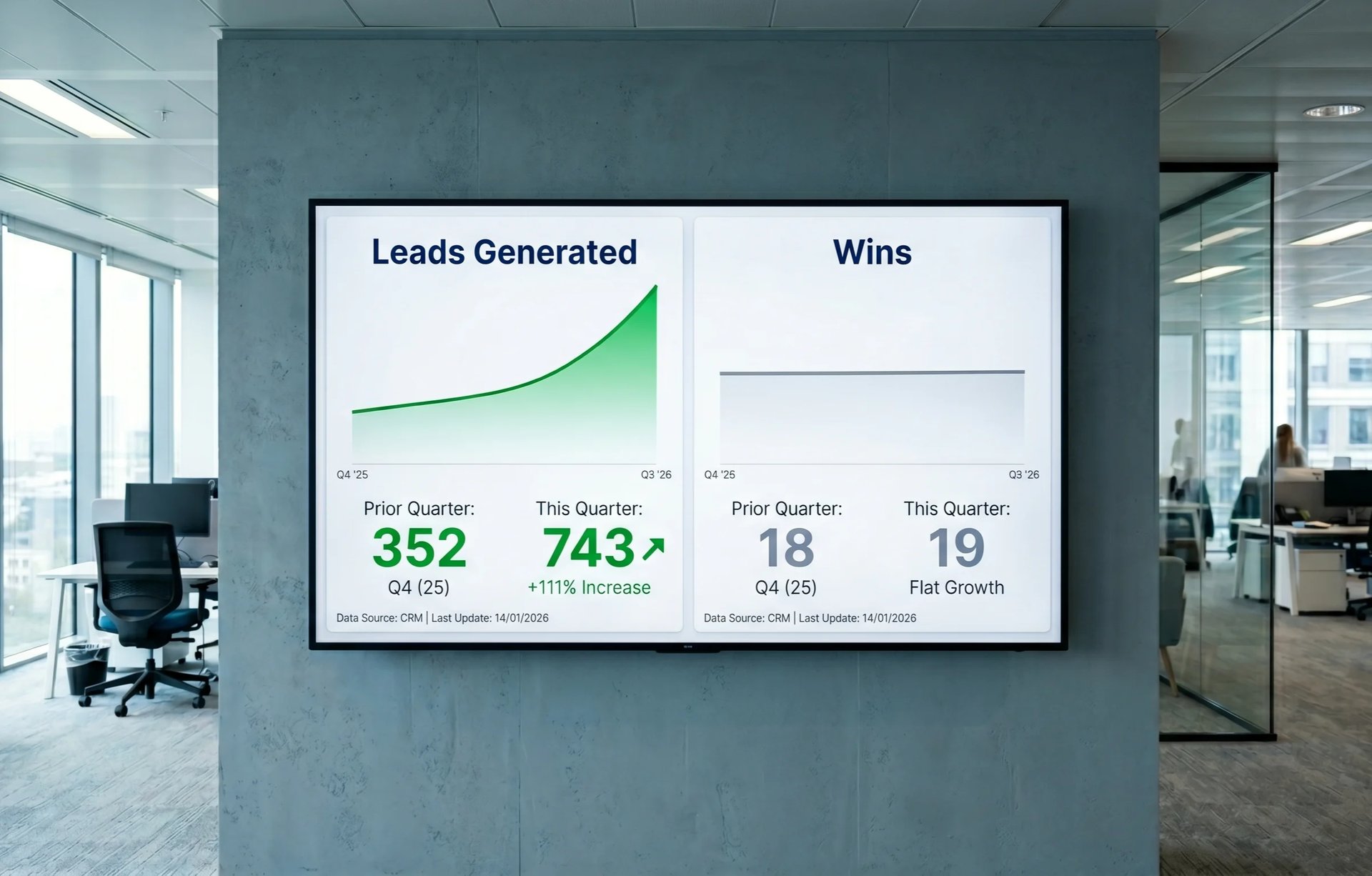
You are in a quarterly review. Leads are up. Content output doubled in 60 days. Outbound is automated. Every activity metric is moving in the right direction.
Then someone asks the question.
If we are generating twice as many leads, why are we not closing more deals?
No prompt refinement fixes that. No workflow adjustment addresses it. The problem is not the tool. The problem is what the tool is being applied to.
Most marketing leaders misread this moment the same way. They look at execution. Prompts need refinement. Workflows need optimization. The team needs more time. Reasonable explanations. Wrong diagnosis.
AI does not fix execution problems. It amplifies definition problems.
Unclear ICP? AI reaches the wrong people faster. Inconsistent messaging? AI spreads it across every channel at a scale that was not possible before. Marketing and sales misaligned on what a good customer looks like? AI turns that misalignment into more conversations that go nowhere, burning time on both sides.
AI did not create any of those problems. It just put them in every room you walk into.
AI reaches the wrong people faster
Spread across every channel at scale
Marketing & sales disagree on ideal customer
Before AI, most mid-market B2B marketing systems run on low definitional clarity, moderate activity, and inconsistent results. The gaps are real. The volume is manageable. Problems get explained away.
After AI, the clarity stays the same. The activity multiplies. You did not fix the system. You increased the volume running through it.
Here is what that looks like: a SaaS company tightens its outbound motion using AI, triples weekly touchpoints in a month, and watches booked meetings climb. Leadership reads it as confirmation the investment is working. But the ICP was loosely defined -- broad vertical coverage, wide employee count range, no clear criteria for who actually closes. So the meetings reflect that looseness. Sales starts rejecting. Marketing defends the volume numbers. Leadership starts asking whether marketing understands the business. Three months in, the team is exhausted and pipeline quality is worse than before the AI rollout.
They were not scaling a strategy. They were scaling assumptions.
When activity increases without definitional clarity, outcomes do not hold steady. They degrade.
More leads, lower quality. Sales spends more time qualifying and rejecting than selling. Conversion drops. Trust breaks: sales loses confidence in marketing, marketing defends activity metrics instead of revenue, leadership loses confidence in both.
What looked like leverage becomes noise.
The instinct is to get more out of AI. That is the wrong move.
Step back and fix what AI is exposing. Stop optimizing tools in isolation. Shift from execution to definition.
Get clear on who you actually win with -- not who the website is written for, but the customer profile the whole organization would agree on if marketing, sales, and leadership were in the same room. Clarify how you create value for that customer in language that holds across every channel and every conversation. Build a system that connects targeting, messaging, and conversion.
Then apply AI.
Clarity first. Alignment second. System third. Scale last.
Not a sequencing preference. A description of how compounding works: you only get it when the underlying unit is sound.
The companies winning right now are not the ones extracting the most from AI. They are the ones who read performance pressure as a signal, fixed what was broken underneath, and then used AI to scale something worth scaling.
If your output is up and your results are not, you do not have an AI problem. You have a clarity problem that AI is forcing you to see. The question is whether you call it a tool failure or the most honest feedback your growth system has ever given you.
Most teams choose tool failure. It is easier. And it buys another quarter before the real conversation.
The Key Takeaway
If your output is up and your results are not, you do not have an AI problem. You have a clarity problem that AI is forcing you to see.
If your AI initiatives are producing more activity but not better results, the problem isn't the tool. It's what's underneath it. Our Market Perception Audit shows you exactly where buyers are putting you, and how to take control of that positioning before you scale.
Trusted by B2B companies ready to build growth systems that compound