The number you charge doesn't live at the bottom of the funnel.
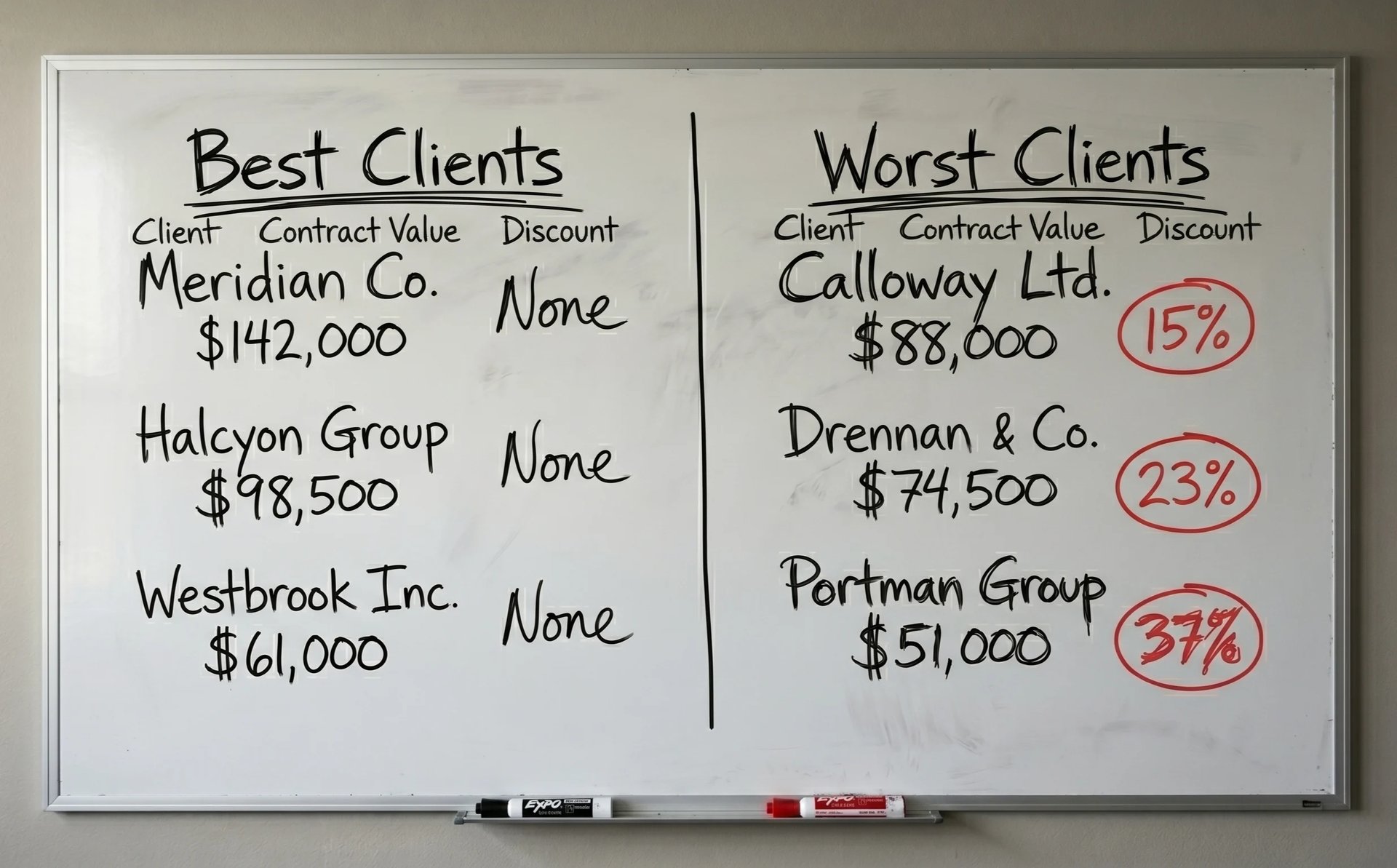
The clients making your business hardest to run are probably your lowest-priced ones.
That's not a coincidence.
Your most difficult client right now almost certainly didn't pay your full rate. Think about that before you read the rest of this.
Most founders frame this as a pricing problem. It isn't. It's a positioning failure with a price tag on it.
Before the deck, before discovery, before anyone on your team says a word, the number has already done something. It has sorted your prospect into a feeling. These people are premium. These people are accessible. These people are a risk.
Price is the fastest signal a buyer processes, and it lands before they have context to evaluate it properly.
Most companies didn't consciously choose their pricing.
They set something, got resistance, discounted to close, and repeated until the market effectively chose the number for them. The result isn't a margin problem. The result is that the filter got handed to the wrong buyers, and it has been working against you ever since.
A prospect negotiates 15% off to close. Your team adjusts scope slightly to protect margin. Six months in, they want more than the contract covers and reference the original price when you push back. They didn't buy a partnership. They bought a transaction, and they're managing it accordingly.
Your delivery team adapts. Onboarding gets more detailed to manage the friction this client type brings. Account management turns reactive. The team members who used to run their own projects are now largely absorbing this account's escalations.
No one decided to build the business around this client. It happened one accommodation at a time.
You don't build your business around your strategy.
You build it around the clients you actually close.
This is how pricing damage compounds, not in a bad quarter, but in the slow drift of what your business becomes optimized for and who it's actually capable of serving well.
Pull your last 20 closed deals. Flag every one that involved a discount. Now answer:
If discounting appears in more than 30% of your deals, you have a structural misalignment.
It traces to one of three places:
1. The Problem
Isn't painful enough for the buyers you're attracting
2. The Proof
Isn't strong enough to hold the number
3. The Fit
You are the wrong solution for the market you're in front of
Each of those has a different fix. A lower price isn't any of them.
When deals die on price, the comfortable interpretation is: the market is cost-conscious and we need to be flexible. It feels like pragmatism. It's usually avoidance.
Price sensitivity is what buyers default to when they don't fully understand, or don't fully feel, the problem you solve.
A buyer who is genuinely in pain from an expensive, urgent problem does not optimize for fee. They optimize for confidence. If they're negotiating your rate before the second conversation, one of three things is true: the problem isn't acute enough, you haven't established the stakes before the number appeared, or they're not the right buyer.
The reflex is to benchmark. Find what similar companies charge and land somewhere in range. Understandable. Almost always wrong.
Competitor pricing tells you what other companies have decided to charge. It tells you nothing about the actual cost of the problem you solve, or what a buyer would rationally pay to make it stop.
When you underprice a high-stakes problem, you don't look like a bargain. You look like a risk.
If the problem is expensive and your fee is modest, the buyer's instinct isn't relief. It's suspicion. The price signals that either you don't understand the magnitude of what they're dealing with, or the solution isn't as substantial as they need. Both interpretations lose the deal, or worse, win it for the wrong reasons.
Price to the intensity of the problem. That's the only benchmark that matters.
The absolute number matters less than the relationship between your price and your proof.
High Price
+ Thin Evidence
= Unresolvable Friction
Low Price
+ Strong Story
= Undermined Credibility
A high price with thin evidence creates friction no sales process can fully overcome. The buyer senses the gap and stalls. A low price with a strong value story creates a different problem: the number undermines the story. When the stakes are high and the fee feels low, buyers don't feel lucky. They feel uncertain.
Before a number appears, the cost of the problem, in revenue lost, time burned, risk carried, needs to already be established. Not as a tactic. As a prerequisite. When that sequencing is right, the fee doesn't feel like a lot. It feels like the logical response to a problem that size.
Get the sequencing wrong, and no price point saves you.
Think about your best-fit clients, the ones who got disproportionate value, referred without being asked, and never once made you question whether the deal was worth it. Not your easiest closes. Not your highest revenue accounts. The ones where the work was right and the relationship held.
What did they pay? What was the cost of the problem before they hired you? What would have happened if they'd waited another year?
Price to that buyer. Let the number filter out everyone else, not as a strategy, but as a structural commitment to the clients your business is actually built to serve.
Then hold it. Discounting for the right client in a genuine edge case is judgment. Discounting as a pattern is a signal that the filter isn't working, and lowering the number further only guarantees it works less.
The number you charge doesn't live at the bottom of the funnel. It runs through the entire system, and the damage from a misaligned price follows a predictable sequence.
The wrong price attracts the wrong buyers.
Wrong buyers create delivery strain because your model wasn't built for their friction. Delivery strain pulls your team into reactive mode, which kills the capacity for proof: the case studies, outcomes, and referrals that justify your price to the next buyer. Without that proof, the next sales cycle starts weaker. The rep discounts to close. The cycle repeats.
The right price, one that reflects your actual positioning and attracts your actual best client, loads every downstream stage of the system in the right direction.
That's compounding. And it starts with a number you're willing to hold.
Not whether to revisit your pricing. At this point, you know. The question is what's actually driving the gap between the business you meant to build and the one you're running.
Start here.
If you removed discounting tomorrow, which deals disappear?
Should they have closed in the first place?
What does your current price communicate before any context is given?
Is that the signal you intend to send?
Were your most difficult clients also your lowest-priced ones?
If the answers are uncomfortable, that isn't a pricing problem.
It's a positioning problem, and the longer you treat it as a number to adjust rather than a system to fix, the more the business hardens around clients you didn't choose and can't fully serve.
Book a working session with a Growth Architect and we'll show you exactly where your pricing positioning is creating drag on growth and how to fix it for good.