
It started off really well.
I don't say that lightly. Most ads I scroll past without a second thought. This one stopped me. It was specific. It was clear. It spoke directly to a real problem I was trying to solve for one of our businesses. No fluff, no vague promises. Just a message that felt like it was written for me. That's rare. Genuinely rare. And my reaction wasn't skepticism. It was curiosity.
I clicked through.
"The first real interaction after someone opts in isn't admin. It isn't operations. It's where a prospect decides whether the experience matches the promise."
From "This company has it together" to "What is happening?"
The exact moment a perfect first impression was destroyed
The funnel that actually worked
The website matched the ad. That's not as common as it should be. Same tone, same message, same level of specificity. I kept reading. I started to recognize myself in their description of the customer they serve. Trust was building. Interest was growing. By the time I reached the call-to-action, I wasn't being pushed. I was ready. I booked a call.
And then it got even better. After booking, I received a short video: clear, personal, setting expectations for the call. My internal reaction was something close to admiration. This is how it should be done. I'd been through enough clunky booking experiences to appreciate a team that clearly had their process dialed in. I was engaged, excited, and ready to talk.
They had done something extraordinary: they broke through the noise, built genuine interest, and got a qualified prospect to raise their hand. For most businesses, that's the hardest part. They had cleared it.
In just a few hours. From three different senders.
Then the inbox exploded
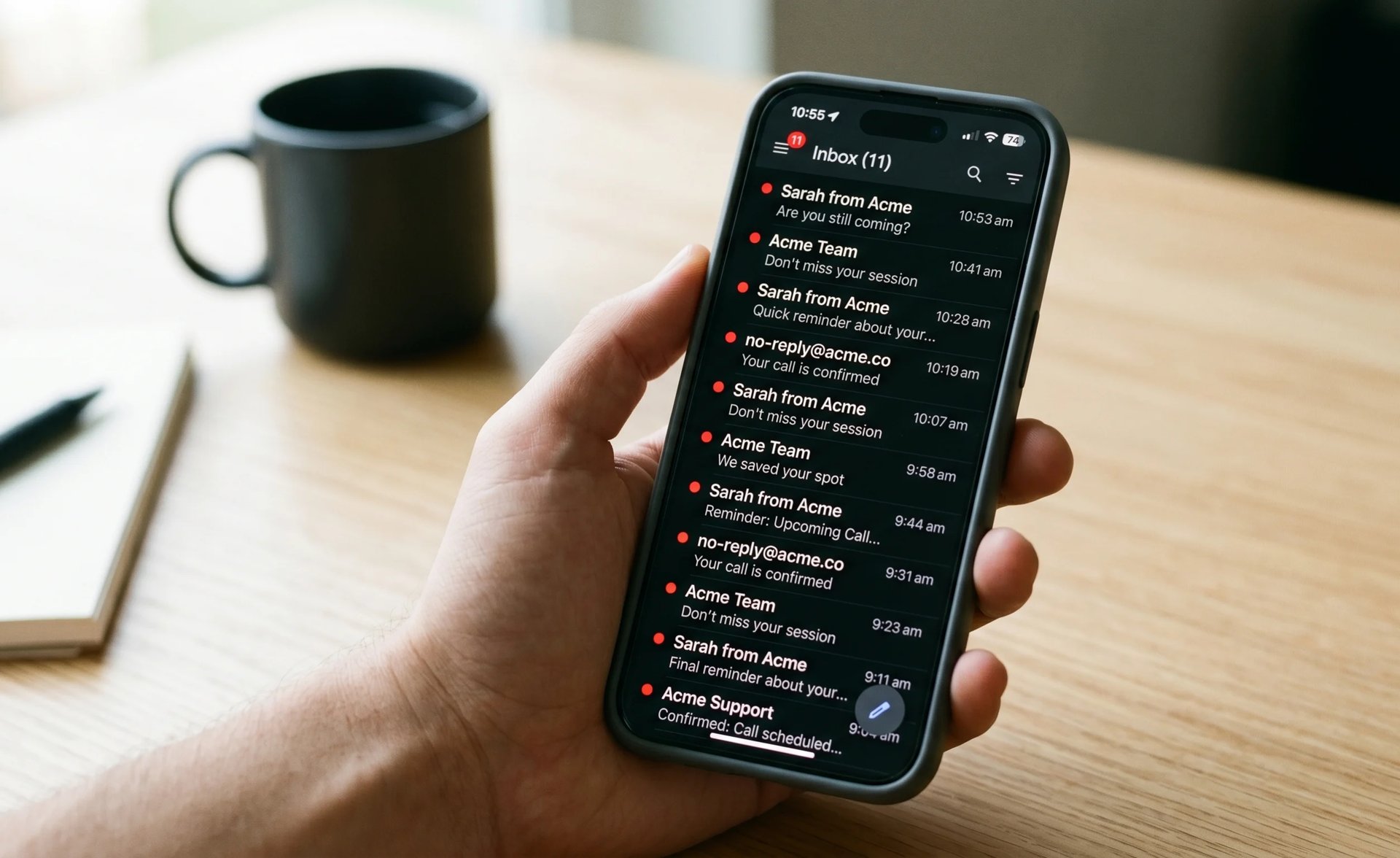
Within a few hours of booking the call, I received 11 emails.
Eleven. In a few hours. From three different senders. Some from no-reply addresses. And then the texts started.
The tone shifted immediately, from thoughtful and intentional to frantic and automated. Each email felt like it had been designed in isolation, with no awareness that I had already done what they were asking me to do. I'd booked the call. The deal was done. But the system didn't know that, or didn't care.
Within a few hours, the experience had gone from "this company has it together" to "what is happening."
The shift wasn't logical. It was instinctual.
Here's the thing I want to be clear about: I was still interested in the service itself. That hadn't changed. What changed was how the experience was making me feel, and that feeling started to override everything else.
Not "too many emails" in some abstract sense. That's not really the problem. The problem was what those emails were implying. Disorganization. Lack of awareness. A system that couldn't read the room. And without ever having a real conversation with this company, I was already forming a picture of what it would feel like to work with them.
It felt overwhelming. It felt pushy. And in my gut, I started wondering: if this is how they treat a new prospect, what does the working relationship look like?
The Real Problem
Without ever having a real conversation, I was already forming a picture of what it would feel like to work with them. That's the invisible cost.
I cancelled the call.
- Specific, targeted ad that spoke to my problem
- Website matched the ad's message and tone
- Personal follow-up video that set expectations
- I was engaged, excited, and ready to talk
- 11 emails in a few hours from multiple senders
- No-reply addresses with no personal touch
- System didn't acknowledge what I'd already done
- I cancelled and disengaged entirely
Then they compounded it
After I cancelled, calls came in trying to save the meeting. I was still open to talking, just not ready to commit to a full call yet. So I offered a smaller step: a 15-minute conversation. Something lighter. A chance to rebuild some goodwill and re-establish the kind of tone their ad had originally set.
They responded by routing me back through the same full booking process.
The emails continued. The outreach continued. None of it adjusted to the context. None of it acknowledged where we actually were in the conversation. It was a system designed to prevent drop-off, not to create a good interaction. And ironically, it was exactly what was causing me to drop off.
I disengaged entirely.
They broke through the noise. They built real interest. They got me to raise my hand. And they lost it in the first real interaction after I did.
The principle at work here
The early engagement stage, the first real interaction after someone opts in, isn't admin. It isn't operations. It's the moment where a prospect decides whether the experience of working with you matches the promise you made to get their attention.
Your first impression doesn't just create a feeling in the moment. It becomes the assumed reality of the long-term relationship. The pacing, the tone, the level of awareness: all of it gets extrapolated forward. People aren't just evaluating your service. They're evaluating what it's going to feel like to be your client.
Process matters as much as messaging at this stage. Maybe more.
Why teams get this wrong
Because they're measuring the wrong things. Activity metrics like emails sent, calls attempted, and follow-up sequences completed look like effort. And in most systems, effort is rewarded. More follow-up is assumed to mean better conversion. More touchpoints means more chances.
But the prospect isn't experiencing metrics. They're experiencing a feeling. And that feeling accumulates fast.
The mistake this company made wasn't laziness. Their system was clearly sophisticated. The mistake was designing a system optimized to prevent drop-off rather than one designed to create a great interaction. Those two things are not the same goal, and when you optimize for the former, you often cause the latter.
Key Takeaway
The mistake was designing a system optimized to prevent drop-off rather than one designed to create a great interaction. Those two things are not the same goal.
The Trap
When you optimize for preventing drop-off, you often cause it. The system creates the very problem it's trying to solve.
The quiet cost of getting this wrong
The most dangerous part of this kind of failure is that it's invisible. No one flags it. The lead goes cold, and the assumption is that it wasn't a fit, or the timing was off, or the prospect wasn't serious. The real cause, that a qualified and interested prospect was pushed away by the experience, rarely surfaces in a post-mortem.
The Critical Window
When the real problem usually hides
Companies think they have a top-of-funnel problem. But sometimes the funnel is working exactly as intended, and the problem is what happens in the first 48 hours after someone opts in.
Companies think they have a top-of-funnel problem. More leads, better targeting, smarter ads. But sometimes the funnel is working exactly as intended, and the problem is what happens in the first 48 hours after someone opts in.
In this case, the top of funnel was exceptional. The ad was excellent. The website was excellent. The onboarding video was excellent. Everything up to the moment I gave them my time and attention was built with care and intention. And then the experience handed off to a machine that had no idea who I was or what I'd already done.
Small changes at this stage, better pacing, fewer senders, awareness of engagement signals, a system that responds rather than just fires, can have an outsized impact on conversion. Not because they add more pressure. Because they remove friction. Because they make a prospect feel seen rather than chased.
The opportunity was there. They earned it. That's the part that stings: they did the hard work of getting someone like me to pay attention and act. And then the experience they handed me off to undid all of it.
That's a solvable problem. Most companies just don't know it's the one they have.
Have you experienced something similar, on either side of the table? I'd be curious to hear how teams have solved this. Drop a comment or reach out directly.
The Stinger
They broke through the noise. They built real interest. They got me to raise my hand. And they lost it in the first real interaction after I did.