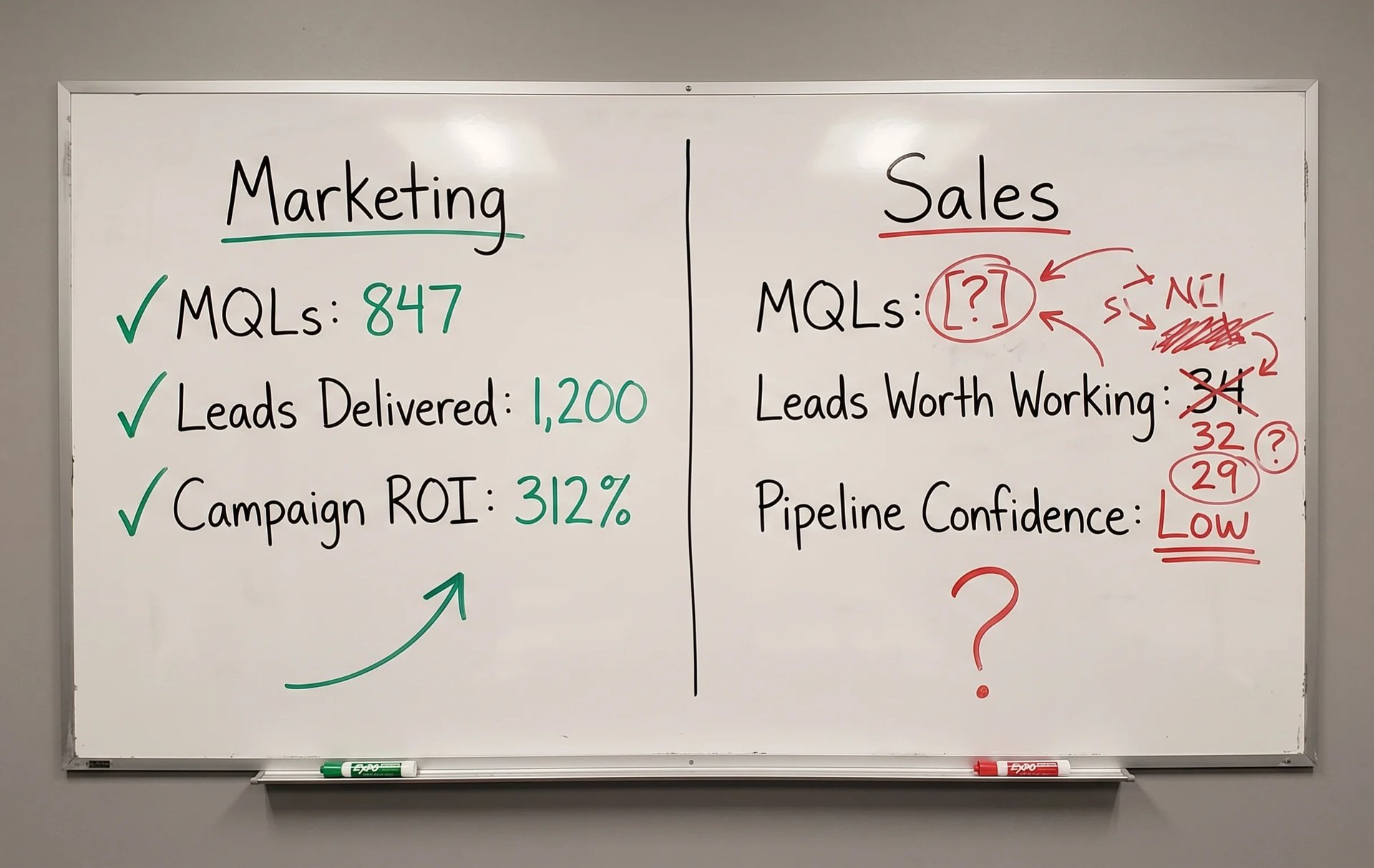

When sales and marketing can't agree on what "qualified" means before a campaign launches, you're not building pipeline, you're building noise.
The Performance Gap
Rep A converts 25% of last quarter's campaign leads. Rep B converts 8%. Rep C works half of them and ignores the rest.
Same leads. Same campaign. Same week.
Most companies look at that and see a training problem. They're wrong.
The variance isn't the problem. The variance is the symptom. The problem is that three people are interpreting the same lead in three completely different ways, because no one ever told them what a good opportunity actually looks like.
1 The Blame Loop Everyone's Stuck In
Marketing hits MQL targets. Sales says the leads aren't closing. Leadership watches pipeline swell while revenue stays flat. Everyone is technically right. That's not a communications failure. It's a structural one.
Research from Forrester
<10%
Average MQL-to-opportunity conversion across B2B SaaS
Most teams absorb that as a cost of doing business. Few ask the more uncomfortable question: if nine out of ten "qualified" leads go nowhere, what did the word "qualified" actually mean?
When there's no shared definition of a qualified opportunity, every rep builds their own. What counts as real intent. What pain level is worth pursuing. What context is "enough" to act on. Sales isn't being inconsistent. They're filling a vacuum the system left open.
Now layer campaigns on top of that. Each one targets a slightly different persona, uses different messaging, signals different urgency. From the rep's perspective, the definition of pipeline changes every week. They're not deprioritizing your leads out of laziness. They're responding rationally to irrational inputs.
2 The Question Nobody Asks Before Launch
Most growth-stage SaaS companies define qualified opportunity through a combination of gut, seniority, and whatever the last sales QBR argued. Marketing calls something an MQL when it hits a lead score threshold. Sales decides whether to work it based on context that was never specified. The two systems never actually touch.
That gap is where pipeline reliability dies. Not in the campaign. Not in the follow-up cadence. In the absence of a shared standard.
Before your next campaign, require an answer from both teams: Would marketing and sales independently agree this is a high-quality opportunity? Not roughly. Specifically. What signals? What context? What does "ready" actually mean?
If the honest answer is "it depends," you've found your bottleneck.
3 The Fix Nobody Wants to Do
Defining conversion criteria before a campaign launches slows things down. That's why it doesn't happen. But consider what the alternative actually costs: campaigns that generate volume without velocity, pipeline reviews that become post-mortems, and sales teams that quietly stop working marketing-sourced leads because experience taught them not to trust them.
The standard for a qualified opportunity should be tight enough that marketing and sales can both name it without looking at each other.
This is not a lead quality problem
and it's not a sales execution problem.
It's a sequencing problem.
You're generating demand before you've defined what you're looking for.
4 What It Actually Takes to Fix It
Pull your current open pipeline. Have both teams score it independently, no huddle, no alignment call first. Where the lists diverge, that's not a data problem. That's the gap your next campaign will fall straight into.
The companies with consistent revenue aren't running better campaigns. They've agreed on what they're hunting before they go out.
No targeting improvement, no sequence optimization, no rep training closes a definition gap.
You have to close it yourself, before the next launch, or you'll be having this same pipeline conversation next quarter.