Why the frame buyers put you in is costing you deals, and how to change it.
You've tightened the ICP. Cleaned up the website. Sharpened the messaging. Sales conversations are better than they've ever been. And still: deals stall, weaker competitors keep making it to the final round, and buyers who tell you they see the value turn around and negotiate like they're buying something ordinary.
The instinct is to go back and fix the positioning. Understandable. But usually wrong.
The problem isn't your positioning. It's the category your positioning lives inside. Sharper messaging won't fix that. It just makes you a more polished version of something the buyer already knows how to evaluate and push back on. You don't need better positioning. You need to stop letting the category set the terms for how buyers decide.
When a buyer recognizes your category, they stop evaluating and start assuming. Before you've said anything, they've already decided what you probably do, what you should cost, who else they should look at, what questions to ask, and what a reasonable outcome looks like.
When those assumptions work in your favor, the category helps you. When they don't, it's the first obstacle between you and the deal.
Most CEOs underestimate this. They believe buyers arrive open-minded and evaluate each option on its merits. Most don't. They arrive with a mental model already in place, shaped by every similar vendor they've worked with before, some of whom let them down.
Here's what that looks like in practice. A $14M operations consultancy spent two years improving their methodology, building case studies, and refining their pitch. They were closing about 30% of qualified opportunities, not because buyers doubted the quality of their work, but because buyers kept comparing them to generalist consultants who charged 40% less.
They weren't losing on the merits. They were losing because every prospect arrived having already answered the most important question: what should something like this cost?
They were stuck inside a price range set by firms they would never consider peers, judged by criteria they didn't choose, in comparisons they never agreed to.
Nothing in their sales process could solve that. The buyer's frame was set before the first call.
You may not have created that history. But you're absorbing the cost of it, in every negotiation, every stalled deal, every time a buyer who genuinely understands your value still pushes back on your price.
Management consultants spend their first meeting overcoming skepticism about recommendations that never get implemented. Marketing agencies walk in behind a long history of activity reports that had nothing to do with revenue. IT providers inherit the frustration of missed response times and overpromised results. Fractional executives fight the perception of being peripheral to the business rather than inside it.
You may be nothing like those firms. It doesn't matter. The buyer's skepticism is already there.
When buyers file you as an agency, they expect campaigns. As a consultant, they expect a report. As an MSP, they expect support tickets.
But what if what you actually deliver is something more fundamental: a reduction in operational risk, more predictable revenue, better decisions, stronger organizational alignment? The category has given the buyer the wrong measuring stick. They're evaluating you on criteria that have nothing to do with the outcome you actually create.
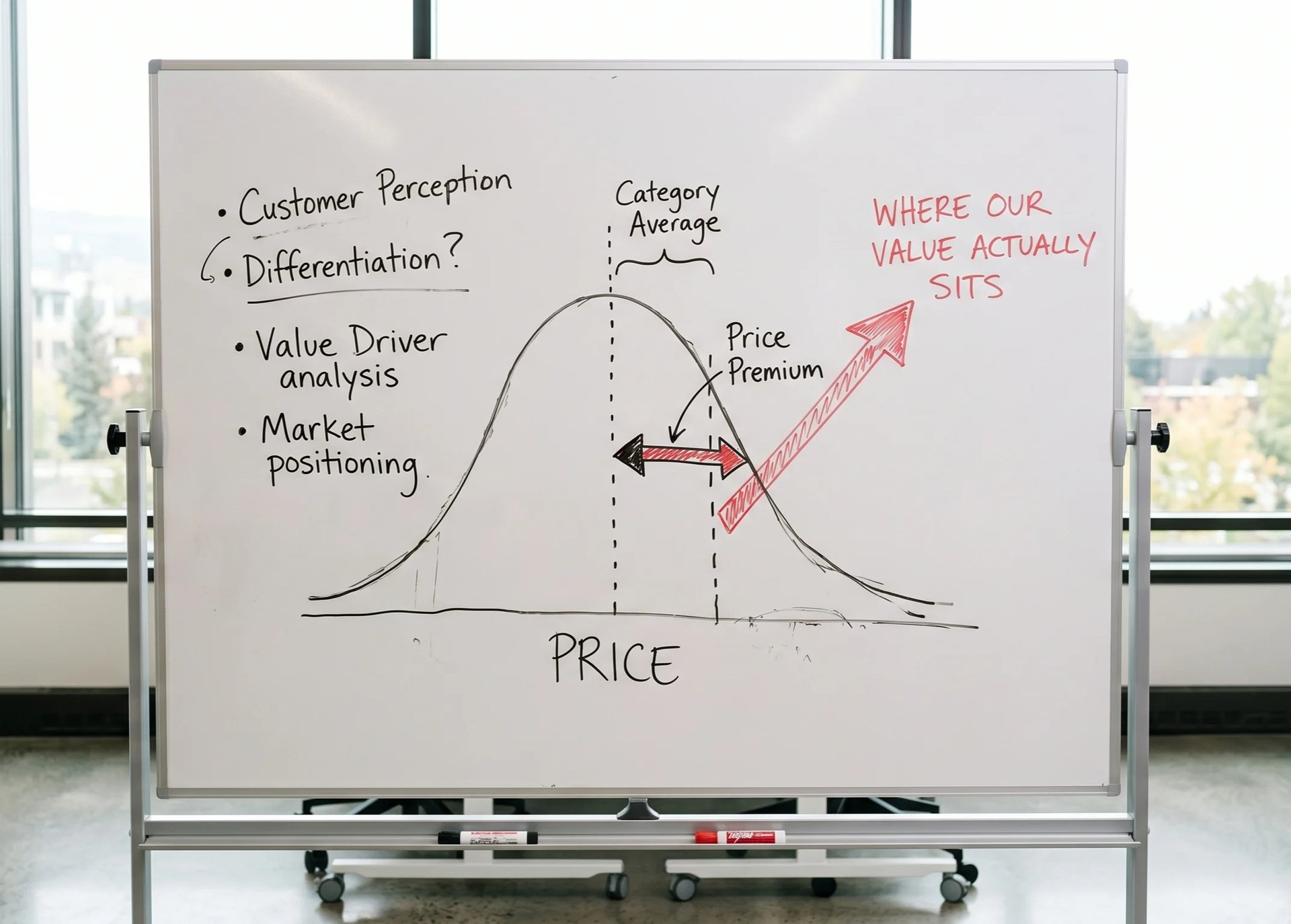
Every category has an informal price range that buyers consider reasonable. That range is based on what typical providers charge, not the best ones. So when your fees reflect the actual value you create, they feel high relative to the category, even when the buyer agrees with your logic.
You can't talk your way out of that in a pricing conversation. The only way past it is to change what the buyer believes they're buying.
Buyers compare you to whoever they've put in the same category. That often includes firms with weaker delivery, different business models, and lower standards.
Once a buyer is comparing you at the category level, you're already in a commoditized conversation. The comparison itself is the problem, not the outcome of it.
Sales problems are usually disguised as something else. A lost deal looks like a price issue. A stalled deal looks like bad timing. A recurring objection looks like a messaging gap. But when the same pattern keeps showing up across different prospects, different salespeople, different stages of the funnel, it's worth looking at what's underneath.
The buyer was engaged. They asked good questions. They seemed convinced. Then they went with someone else, someone you know isn't as strong. This isn't a sales problem. It means the buyer left your conversation and re-evaluated you through the category's lens before they made their decision. You got to them, but the frame got to them after you did.
Different companies, different contacts, same hesitation. When resistance is that consistent, it's not about the individual buyer. It's a category assumption underneath the objection, one that shows up again and again because it was there before you started, and nothing in the conversation has addressed it at the level where it lives.
"We're a consulting firm, but not like the typical ones." "We're an agency, but much more strategic." "We do marketing, but it's really more like..."
When you find yourself reaching for a but right after naming your category, that's a signal. You've accepted the label and you're trying to walk back its implications in the same sentence. The category has defined you, and some part of you knows it isn't quite right.
If you recognized yourself in more than one of these, the issue isn't your positioning. It's the frame the positioning sits inside. That's a different problem, and it needs a different solution.
The natural response is to get better at competing within the category. Stronger proof points. Better case studies. More precise differentiation from the obvious alternatives.
But winning inside the category means accepting its rules. Same price ceiling. Same comparison set. Same evaluation criteria. You get better results inside a frame that was never designed to reflect your actual value.
Compounded over time, this looks like: a sales team that keeps developing, a pipeline that keeps growing, close rates that don't move. The effort is real. The output isn't there. Not because the work is poor, but because the frame around the work is limiting what it can convert into.
Improving your tactics is not the same as solving your conversion problem. If the frame is broken, better execution inside it produces better-looking friction, not better outcomes.
Buyers don't actually buy categories. They buy solutions to specific problems, progress toward specific outcomes, and confidence that a real risk in their business is going to be handled well. Categories are just the shortcut they use when they haven't been given a better way to think about the decision.
Your job is to give them a better way.
Generic:
"We're a managed service provider."
Specific:
"We work with professional services firms between $10M and $50M that are dealing with IT risk they've outgrown, where the infrastructure has gotten more complex than the strategy behind it."
The second version doesn't slot neatly into the MSP category. That's the point. It lands in a different part of the buyer's mind, not "vendor to evaluate" but "this is exactly my situation." That reframe changes the nature of the conversation before it starts.
Deliverables, reports, campaigns, resolved tickets, are easy to compare. The moment you lead with what you produce, you've invited the buyer to benchmark it against every other provider who produces something similar.
Outcomes are harder to commoditize. A $9M revenue consultancy stopped describing itself as a fractional CMO service and started describing what it actually produced: a pipeline system that reduced founder dependency within 18 months. Same work. Different frame. Their average deal size grew by more than 60% in two quarters, not because the service changed, but because buyers stopped comparing them to other fractional CMOs and started thinking about the cost of the problem they were solving.
Lead with outcomes and the comparison loses its grip. Lead with deliverables and you've already lost.
Some companies aren't distinctive because of what they deliver. They're distinctive because of how the relationship works: embedded versus external, ongoing versus project-based, accountable for outcomes versus responsible for outputs.
If that's true of your business, it needs to show up in how you describe yourself from the beginning. Not as a detail you reveal once the buyer is already engaged, but as part of the initial frame.
One clarification: this is category reframing, not category creation. Most companies at $5M to $25M don't need to create a new market. They need to control how they're understood within the market they're already in. The goal isn't to confuse buyers. It's to make sure they're evaluating you on the right terms.
By the time a buyer gets on a discovery call, they've already formed a view of what you are. Your website, your LinkedIn presence, your outbound messages, the way someone described you in a referral, all of it has already done its work. The sales conversation doesn't set the frame. It either confirms it or struggles against it.
This is why so many sales motions in companies with a CEO still close to the revenue feel uphill. They are uphill. The buyer arrived with a picture already in mind, and the sales team is spending the first half of every conversation trying to correct it.
The frame needs to be consistent everywhere: how the website positions the company, how the team describes the work, how case studies are written, how proposals are structured, how the CEO talks about what the company does in any room. Every touchpoint either reinforces your frame or hands it back to the category.
If buyers arrive already thinking about their problem in your terms, sales is easier. If they arrive thinking in the category's terms, every conversation starts behind.
These are not complicated questions. They're hard to answer well, because answering them honestly means looking at things most leadership teams have been taking for granted.
Not what you'd like them to assume. What they actually assume, based on everything they can see before a conversation begins.
Write it out: the price range they expect, the skepticism they carry in, the other firms they plan to look at, the past experiences they're filtering you through.
Most companies have never mapped this explicitly. Most find it uncomfortable when they do.
Not in terms of services or deliverables. In terms of the specific problem you solve, for whom, with what result, in a way that's genuinely different from how others approach it.
Most leadership teams can answer this clearly in a candid internal conversation. Very few have built that answer into the way they show up externally.
Go through everything: the website, the proposals, the LinkedIn profiles, the case studies, the email signatures, the way the sales deck opens. Look for language that describes you in terms the category handed you, words and framings that attached themselves to the business without anyone deciding they should be there.
Most companies absorb their category language from the firms that came before them, the clients who described them early on, and the industry they grew up in. Then they're surprised when buyers treat them like everyone else.
The goal isn't to be the best option in your category.
The goal is to make the category the wrong frame for evaluating you at all.
That's a harder shift than refining your positioning. It requires changing how buyers think about the decision before they make it. But it's also where the real leverage is, because once you control the frame, the comparison changes, the price ceiling lifts, and the right buyers start finding you easier to choose.
Everything else is just getting better at a game that was already tilted against you.
Most B2B companies are invisible to the right buyers, not because they lack visibility, but because they're visible inside the wrong frame. Our Market Perception Audit shows you exactly where buyers are putting you, and how to take control of that positioning.
Trusted by B2B companies ready to break free from category constraints