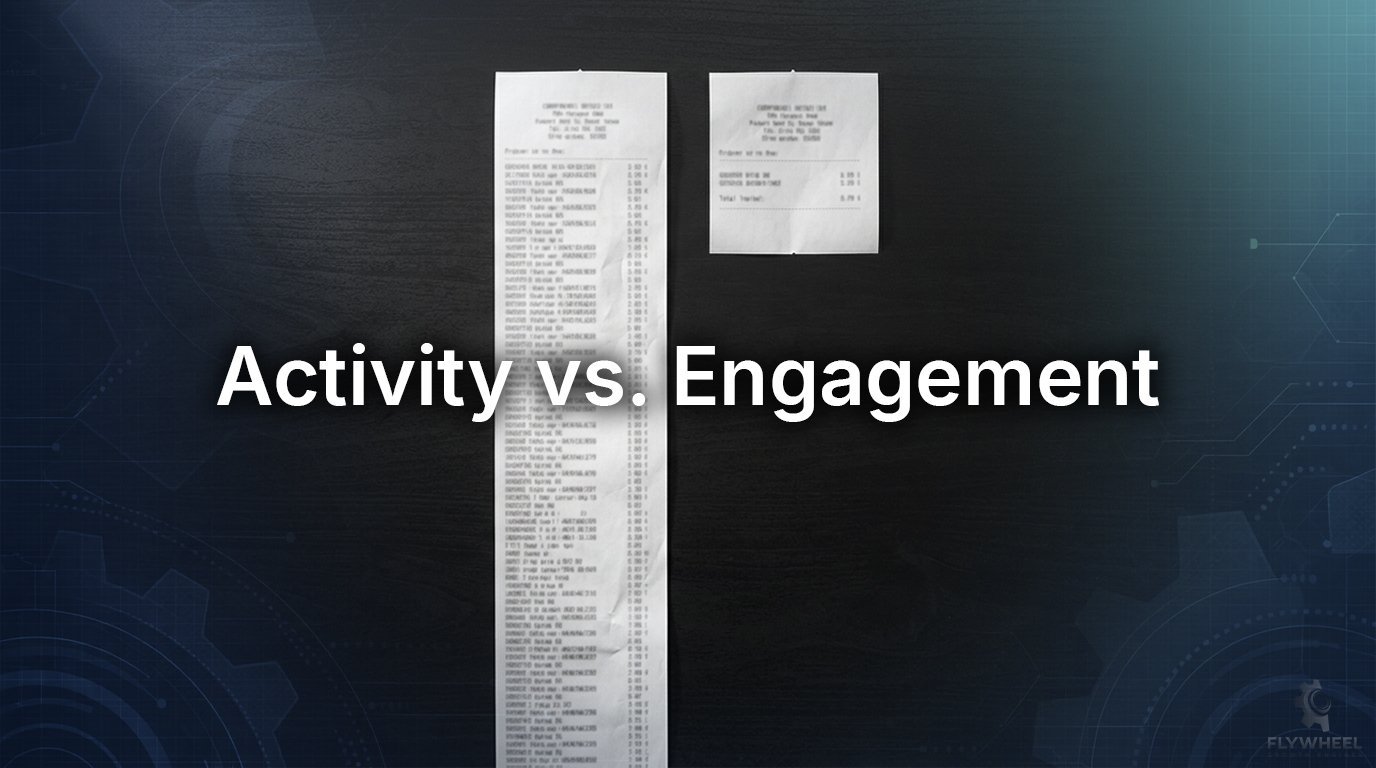
Most B2B teams are doing more outreach than ever and getting less from it. The reason is structural, and it's fixable.
A sales team running 400 emails a week, booking demos, working through three active sequences, and hitting every activity metric on the dashboard can still produce a pipeline that does not move. This is one of the most common patterns in B2B growth, and it gets diagnosed the same way every time: the team needs to push harder, send more, add another sequence, hire another SDR. The instinct is to treat volume as the limiting factor, because volume is the variable leadership can see and control.
Volume is almost never the limiting factor. The problem is that activity has stopped producing meaningful interaction, and meaningful interaction is what actually moves prospects forward. Most companies have not separated those two ideas, which is why they keep solving an interaction problem with more activity. The Engagement Gear is the system that does the separation, and turns the activity that is already happening into the kind of interaction that compounds.
Activity is what shows up in a CRM report. Emails sent, calls dialed, sequences enrolled, meetings booked. It is countable, it is reportable, and it is what most sales teams are measured on. When pipeline slows, increasing activity is the obvious move because activity is the variable everyone can see.
Engagement is what happens between the activity and the prospect. The prospect reads the second email instead of just the first. They come back to the website three times in a week. They complete a diagnostic instead of just clicking the link. They reply with a real question instead of an out-of-office. Each of these is evidence that something landed, which is a different thing from "a sequence was sent."
The gap between activity and engagement is where most B2B pipeline gets lost. A team can hit every activity metric and produce almost no movement, because the activity is not creating the interaction. Volume goes up, noise goes up, and the prospects who would have engaged with a sharper, more relevant approach get tuned out by the same generic sequence as everyone else.
The Engagement Gear has four layers, each doing specific work to close that gap.
The first job is initiating the interaction, and there are two ways it happens. Both are usually broken in the same predictable ways.
Inbound gets treated as content production. The marketing team publishes posts, ebooks, and webinars on a schedule, and assumes that visibility creates interest. It mostly does not. A prospect who reads a blog post and does nothing has not engaged; they have consumed something. Inbound only becomes engagement when the content is designed to guide the prospect toward a clear, low-friction next step that builds on what they just read, usually some form of diagnostic, tool, or short assessment that gives them an answer to the question the article raised. One firm that redesigned its inbound around this principle replaced "book a demo" buttons with a diagnostic that produced a personalized report, and saw conversion into qualified conversations roughly double without any increase in content volume. The progression was the change, not the publishing.
Outbound gets treated as volume. Lists are built, sequences are launched, and messages are sent. Without context, this feels interruptive to the prospect and produces diminishing returns to the team. The fix is not less outbound. It is outbound triggered by a reason: a behavior the prospect took, a signal the system picked up, a contextual moment that makes the outreach relevant rather than random. Outbound that arrives because the prospect just visited the pricing page is a different kind of interaction than outbound that arrives because Tuesday is sequence-launch day. Teams that make this shift commonly cut their outbound volume in half while doubling or tripling their response rate, because the messages going out are landing in moments where the prospect is already paying attention.
The second job is timing. Most engagement systems do not have real timing, because outreach is scheduled and lists are static. The system treats every prospect the same regardless of what they are actually doing, which means it is always interrupting some prospects while missing the moment with others.
Signals introduce a dynamic layer. They tell the system when a prospect is showing real intent, returning to the site, engaging with multiple touchpoints, downloading something specific, and trigger interaction at that moment rather than on a calendar. A prospect who comes back to a pricing page three times in a week is signaling something different than a prospect who opened one email six weeks ago, and a system that treats them the same is wasting effort on one and missing the moment on the other.
Signals also create prioritization, letting the team focus effort on the prospects who are actually moving instead of distributing the same level of attention across every name on the list. This is where the activity-to-interaction shift starts to compound, because less effort applied at better moments produces more meaningful interaction than more effort applied indiscriminately.
The third job is progression. Once a prospect is engaging, the system has to give them a path forward, and most engagement systems get this wrong in two predictable ways.
They use rigid sequences. Every prospect goes through the same five emails regardless of what they did along the way. Someone who replied to email one gets email two anyway. Someone who clicked a link in email three gets the same email four as someone who opened nothing. Engagement Design fixes this by building flexible pathways with multiple entry points and progression logic that adapts to actual behavior. A prospect who engages early gets a different next step than one who is moving slowly. The system meets them where they are instead of where the sequence expects them to be.
They also ask too much, too early, with the first interaction asking for a meeting, and the second, and the third. Value Exchange fixes this by making sure each step earns the next. The first interaction provides something useful (an insight, a tool, a diagnostic) that gives the prospect a reason to take the second step, which delivers something more specific. By the time the system asks for a meeting, the prospect has received three or four pieces of value, and the meeting feels like a continuation of an established conversation rather than a cold ask. Firms that structure progression this way often find that prospects who would have dropped off after one touch in a traditional sequence stay engaged for weeks, because each step gives them something they actually want.
The fourth job is converting interaction into a meaningful sales conversation, which is where the upstream work pays off or fails to.
Conversation Architecture defines what has to happen before a sales conversation begins, so that when it does, both sides start from shared context. The prospect has engaged with a diagnostic, read the relevant content, or completed a tool. The rep is not introducing the company from scratch. The conversation starts at "based on what you've already seen, here's what I think is going on" instead of "let me tell you about us." Sales becomes a continuation of engagement, which makes the conversation faster, sharper, and more likely to lead somewhere. Companies that gate sales conversations behind meaningful engagement consistently see sales cycles compress by 30 to 40 percent, because the rep is no longer doing the work that the system should have done before the meeting started.
Channel Roles make sure the touchpoints across the system are coordinated rather than fragmented. Email, website, outbound, content, and sales should all be telling the same story and reinforcing the same progression. When channels operate independently, the prospect gets inconsistent messaging, mixed signals, and an experience that erodes trust. When they are coordinated, every touchpoint reinforces the last one, and the prospect moves through the system with a sense of continuity rather than a sense of being passed between strangers.
Feedback Loops keep the system honest. Most companies collect engagement data and never use it. A system with real feedback loops watches where prospects engage, drop off, and progress, and uses that information to refine messaging, timing, and pathways over time. The system gets better as it runs, which is what separates a designed engagement system from one that was set up two years ago and has been deteriorating ever since.
The Engagement Gear is not a tactic or a tool. It is a system, and like all systems, it produces compounding results when it is built well and unpredictable results when it is not.
When it works, the change shows up in three specific places. Outbound stops feeling interruptive because it arrives with context. Inbound stops generating traffic without pipeline because every piece of content has a next step. Sales conversations stop starting from scratch because the prospect arrives with shared context, which means the rep is having a different kind of conversation than they were six months ago, with a different kind of prospect.
When it does not work, the team gets stuck in the activity loop. Pipeline slows, the response is more activity, more activity produces more noise, more noise creates lower-quality interactions, and lower-quality interactions slow the pipeline further. Eventually the team is busier than ever and the results are worse than ever, and nobody can quite explain why.
The 400 emails a week were never the problem. The team that sent them was working as hard as anyone could reasonably expect, doing exactly what their system was built to do. The system was built to produce activity, and it produced activity. Building one that produces interaction is different work, and it is the work that finally makes the activity worth something.
Most teams are working harder than ever and getting less from it. The fix isn't more activity. It's a system that turns the activity you're already doing into the kind of engagement that actually moves deals forward.