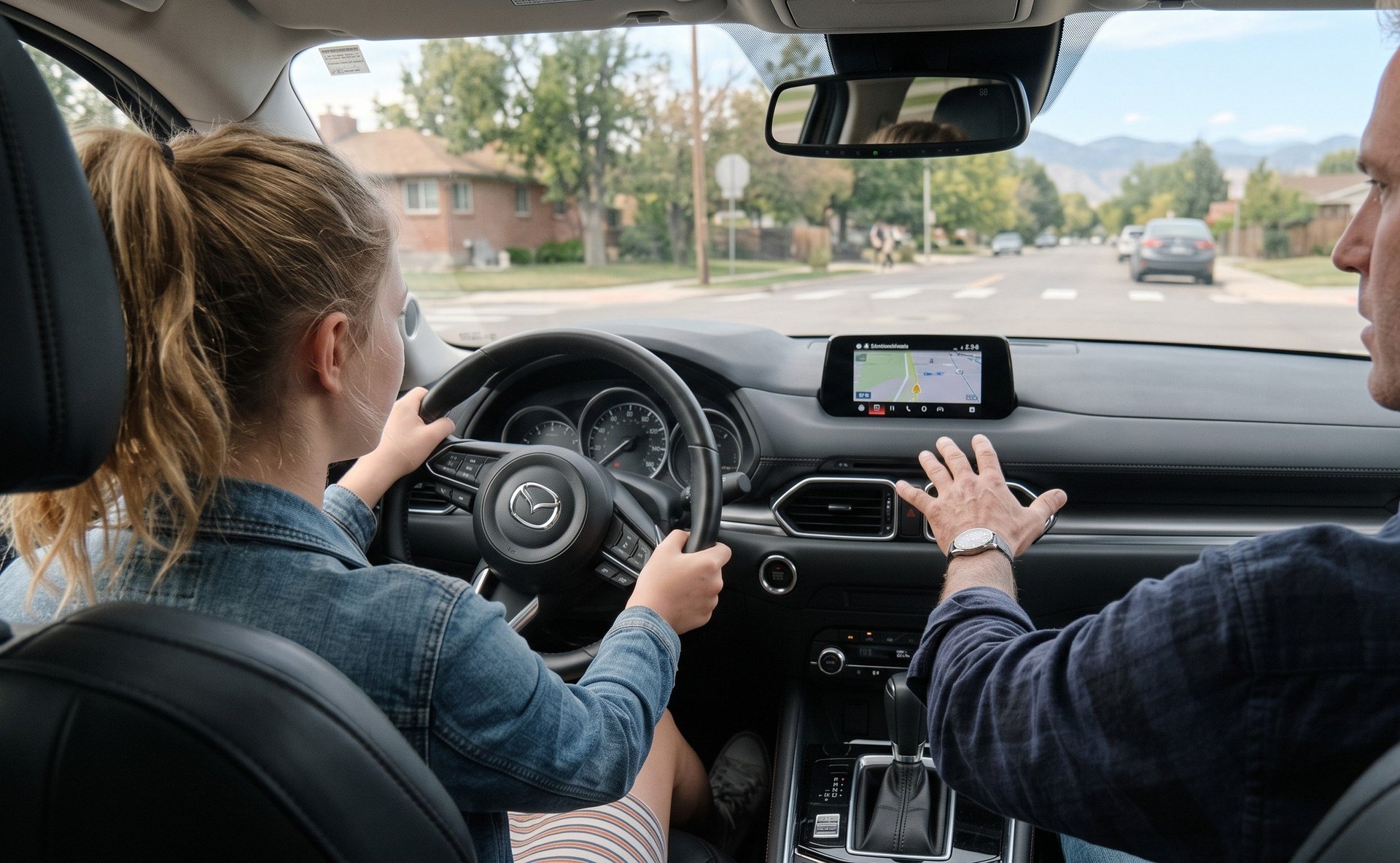

Student driver with blonde hair gripping steering wheel while instructor gestures during driving lesson on suburban street
Leadership September 26, 2026

Giving Up the Wheel

Professional headshot of a man with dark hair and full beard wearing a navy blazer and light blue shirt against blurred office background By Rob Scott 14 min read

My daughter recently got her driver's license, and started driving. I am thrilled for her. I am also, if I am honest, more than a little terrified.

I ride in the passenger seat and I feel my foot press a brake that is not there. My hand drifts toward the wheel on a turn she is taking a hair too wide. Every instinct I have is telling me to take over, because I can see the thing she does not see yet, and the stakes are not small. What if she misjudges the merge. What if she gets in an accident. I am her dad. Grabbing the wheel is the most natural thing in the world.

And it is exactly the wrong thing to do, if I want her to become a good driver.

The same challenge, in scaling a business

Here is what caught me off guard. It is the exact same knot I see founders (including myself) struggle with in the process of scaling a business.

Someone on the team takes the wheel on a client, a proposal, a decision I have made a thousand times, and I watch them line it up a little wrong. My hand starts to move. I can see what they cannot see yet. And the pull to take it back, to just do it myself, is every bit as strong as it is in the passenger seat, for the same reason. I care about the outcome, the stakes feel real.

But I've been given the advice by more than one mentor that you have to give your team the room to fail and to learn from that and continue to improve and grow.

Most writing about owner dependency treats that pull as a flaw to be corrected. I do not think it is a flaw. It is love, or the business version of it, and it is mostly rational. But it is also the single thing most likely to keep your company small and keep you trapped inside it. The same instinct that makes me a good dad in that car makes founders a bottleneck in their business, and telling ourselves to just care less has never once worked.

They really are worse at first

Here is the part most advice skips, and it is the reason so much of it rings hollow. My daughter is not as good of a driver as me, given my 35 years behind the wheel (at least not yet). She brakes late, she drifts wide, she misses things a veteran sees without thinking. That is not me being a control freak. It is just true.

Your team is the same. When you hand off the client or the proposal, it will, at first, be done worse than you would do it. The timeline slips. The email is clumsier. The judgment call is a little off. You are not imagining that, and the people who tell you it is all in your head are not being straight with you. Handing over the wheel usually does go worse at the start. That is not the exception. It is the whole nature of a beginner.

The mistake is not noticing that they are worse right now. The mistake is treating worse right now as worse forever. There is a reason my insurance just doubled when we added her to the policy, a sixteen year old is not yet a great driver for a predictable, temporary reason: not enough reps. There is exactly one way to fix that, and it is not me driving her everywhere until she turns thirty. Although, I am tempted.

But if you never give them the wheel

The only way my daughter becomes a good driver is miles. Her hands on the wheel, mine in my lap, both of us a little tense, mile after mile after mile. Every time I feel the need to reach for the wheel, I would be robbing her of the rep that would have made the next moment better. Do it enough and I guarantee the outcome I am afraid of: a driver who never actually learned to drive, because someone was always there to take over.

When you take the task back because you can do it better right now, you might be correct in the moment, but you are quietly ensuring that the person never gets better, which means you can never hand it off, which means you are still doing it in three years.

Being right in the moment is how you lose the decade.

There is a second cost, and it is yours. As long as you are the only one who can really drive, you never get out of the car. The company cannot go anywhere you are not sitting. That is not a business you own. It is a car you are stuck driving, with a passenger who could have taken a turn behind the wheel if you had let them.

I recently worked with a company that has been in business for 25 years, two partners with a whole team and a quarter century of business and they are still the only two drivers. That far in, changing to the passenger seat is almost impossible. That is why it is so important to start that process as early in your business as you can.

Which mistakes are survivable

Now, the fear underneath all of this is real, and I am not going to wave it away. What if she gets in an accident. Letting go is not the same as closing your eyes and hoping. Good parents do not hand a new driver the keys to a rainy highway at night and wish them luck. You start in an empty parking lot. Then quiet streets. Then bigger roads in daylight. You stay in the car. You are choosing, on purpose, which mistakes are survivable, and letting those happen so the big ones never do.

That distinction is the actual skill, and it is the one the letting-go advice always leaves out. A clipped curb is survivable. A wide turn on an empty street is survivable. Those are not failures, they are the curriculum. The job is not to prevent every mistake. It is to tell the difference between the curb and the crash, allow the curbs freely, and keep your hands ready only for the genuine emergency.

It maps straight onto the business. Let your operations lead quote a job and leave a few points of margin on the table. Let a newer manager run the quarterly review and fumble a question they should have seen coming. Those are curbs. They are how judgment gets built, and they are cheap tuition. What you actually guard against is the small set of things that are not survivable: the bet-the-company client, the legal exposure, the promise you cannot unmake. Reserve the wheel-grab for those. If you are grabbing it for the curbs, you are not managing risk, you are just driving, and your team is still in the passenger seat learning nothing.

Why your hand still reaches for the wheel

So why is it still so hard, even for those of us who know all this?

Part of it is honest risk, which we just covered. But part of it is quieter and worth admitting. Somewhere along the way the company stopped being something I run and started being part of who I am. So when a teammate lines up a client a little wrong, it does not just read as a business risk. It pokes at something more personal, the same way a wide turn from my daughter spikes something in me that a wide turn from a stranger never would. When your identity is fused to the thing, every near-miss feels like your near-miss, and your hand moves before your judgment can vote.

I am not saying that to diagnose anyone. I am saying it because naming it is what lets you catch your own hand. When you feel the reach for the wheel, the useful question is simple. Is this a crash, or is this a curb, and is my hand moving because the stakes are truly high, or because I cannot stand to watch it be done differently than I would do it. Most of the time, if I am honest, it is the second one. Naming that is what turns the grab back into a choice.

The license

The whole point of teaching my daughter to drive was never to have a kid who needs me in the car. It was to raise someone who can go anywhere without me. That is not me losing her. That is the win, and the flinch I feel is just the price of it.

Your company is the same. The goal was never a team that needs you in the seat for every turn. It was a business that can drive itself, so you get to choose where you sit and whether you are even in the car. Getting there means miles of watching people take turns a little wide, letting them clip the curb, keeping your hands ready only for the crash that would actually hurt. It will make you flinch every time. Do it anyway.

Start this week. Pick one thing you would normally take back, something where the worst case is a curb and not a crash, and hand over the wheel. Then sit on your hands and let them drive. Watch how they do, and watch how hard it is for you to stay in your seat. Both of those are the work.

That is how they become drivers, and it is how you finally get to ride.

Still the only one holding the wheel?

If you are the only driver in your business, every turn waits on you. That is not a discipline problem. It is a design problem, and it is fixable. We work with founder-led teams to build the systems, judgment, and handoffs that finally get you out of the driver's seat.

The first mile is always a little tense. It is also the only one that counts.