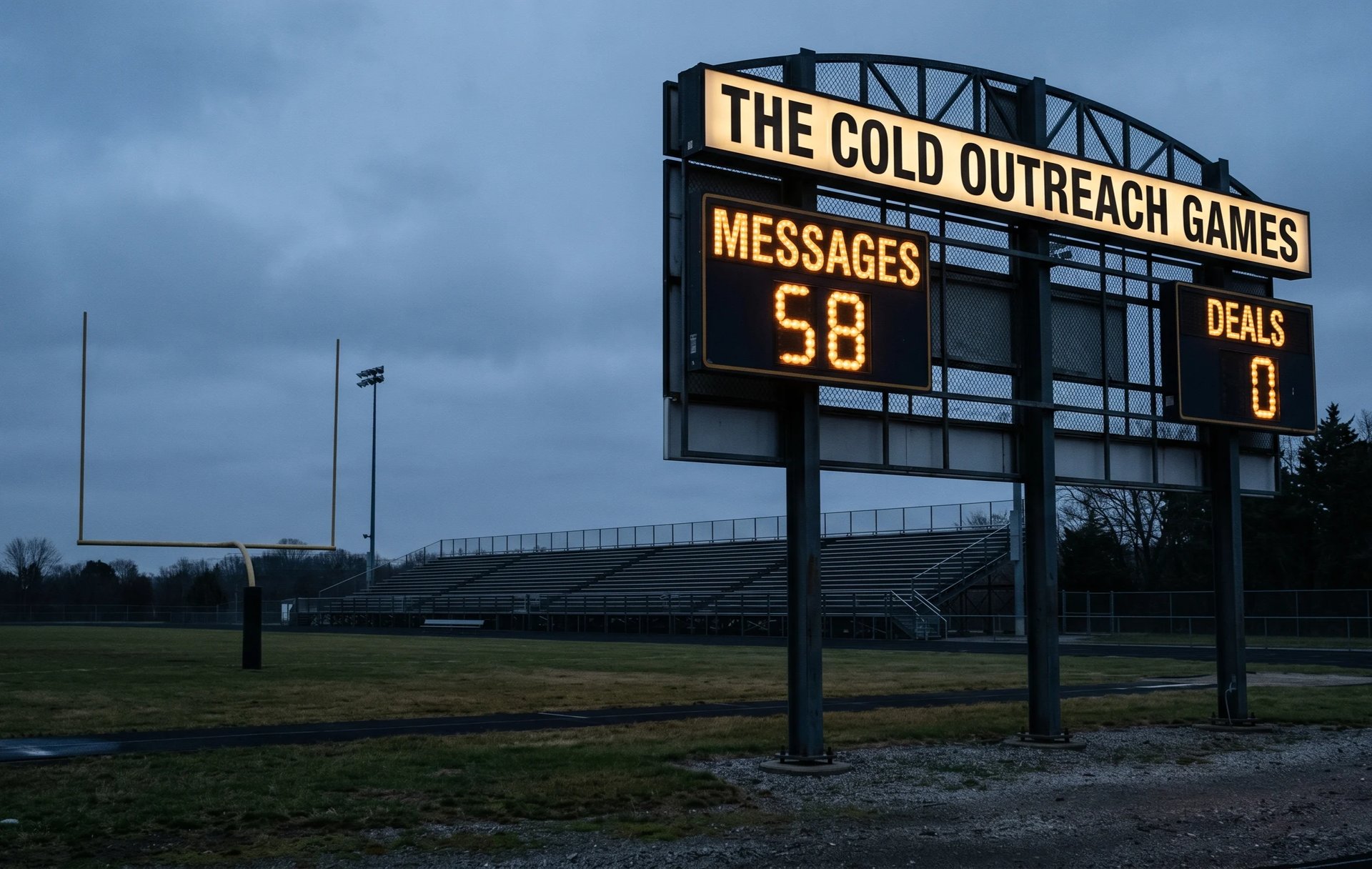
58 cold messages over 30 days, a buyer with real budget, and zero deals. Here is why every message died.
58 cold messages over 30 days, a buyer with real budget, and zero deals. Here is why every message died.
I got back from a week mostly offline with my family and opened LinkedIn with a timer running. I was doing a little experiment. My company builds outreach programs for clients among other ways we help them scale and grow, and I wanted to see exactly what happens when cold messages meet a real buyer's attention.
Roughly 30 messages were waiting. Eleven were cold outreach. The rest were real conversations: clients, partners, prospects. I read and dispositioned all 11 cold messages in well under 3 minutes. The relevance verdict on each took about 3-5 seconds. Three were at least somewhat relevant. I responded to one, cautiously.
Sit with that asymmetry for a second. Someone spent time, tooling, and money to get each of those messages in front of me. Each one got 5 seconds.
That afternoon I decided to dig deeper and I pulled the trailing 30 days: 58 cold outreach messages had hit my inbox. My sent folder showed only 5 responses to those 58. Two of the five were some version of "please stop spamming me," sent after a fourth or fifth touch in a single month. Net result: 3 genuine responses. Roughly 5 percent, right on the industry average.
The outcomes are worse than the rate. One of the three turned into a trainwreck sales process right out of the gate and I exited fast. The other two were headed toward a real conversation until over-automation and a bait-and-switch killed them. Final score: 58 attempts. Zero progressed.
This is not inbox hostility. I respond to dozens of messages every week that are not cold pitches: founders networking, recruiters, people asking smart questions, genuine engagement attempts. Some of those are technically "cold" outreach, but they did not feel like it, so I would not classify them as such. But others are actually cold outreach and the vast majority of those fail. One caveat in fairness: more than half of the irrelevant messages pitched some version of services Flywheel already provides, so my numbers may run hot because I operate in the crowded sales, marketing, and growth services space. The lesson holds anyway.
Here is the part that should bother you. I am heavily investing in my business right now. Real needs, real budget, active purchasing. Every new solution I have bought in recent months, I went and found myself. Not one came through outreach.
The fantasy version of an inbox is one where most of what lands maps to what you actually need and want to buy. Mine should be that inbox right now. It is not even close.
If you are a founder or CEO, run this same audit on your last 30 days. I would bet your inbox and the outcomes look very similar.
I am not throwing rocks from outside the glass house. Flywheel runs outbound campaigns for clients. The conventional wisdom says it is a numbers game: more messages, more calls, more volume. Accept 3% to 7% response rates. Celebrate anything above 10%.
People will show up in the comments claiming 15 percent or better. Most of those claims will not survive scrutiny, though higher rates are absolutely possible. Our own campaign data proves it: some campaigns above 20 percent, others in single digits, and some that moved from roughly 5 percent to over 15 percent after adjustments. Same channel. Different craft.
The variable is not volume. It is whether the message earns the 5 seconds.
1. Your message may sit unseen for days, weeks, or forever. The recipient's timeline is not your sequence cadence.
2. Nobody likes being spammed. An interesting message dies the moment the recipient finds four more behind it.
3. The numbers game is for senders who do not care how their brand is perceived.
4. You get maybe 3 seconds. The message has to land immediately.
"I came across your profile and really respect the level you're operating at." Then the pitch. Dead on the first line. Sixteen of the 58 messages opened with a near-identical version of "I came across your profile", and the compliment contains zero specifics. It could have been written for anyone. Which means it was.
Thirty seconds on Flywheel's website or LinkedIn page shows we sell sales, marketing, and growth strategy services. Pitch me those exact services without acknowledging the overlap and you have proven you did zero vetting. The fix is not avoidance. It is acknowledgment: "I see what you do, and here's why we should still talk." A partner angle, a niche angle, whatever is true. Otherwise you have confirmed you are working a list, not a prospect.
Quick call. Watch this video. Read this thing. Every message wanted my time and offered nothing. Claiming you solve a problem, even a real one I have, is not the same as showing up with something of value to start the conversation.
One message actually grabbed me. Solid open, slightly long middle, relevant offer. Then the closer: "would love to learn more about how it's going with your company, Vistage Worldwide, Inc." Vistage is a CEO peer group I belong to, listed as a position on my profile. My company is Flywheel Growth Engines. Two minutes of human attention would have caught that. One automated field-merge wiped out every bit of credibility the message had built. Automation is not the problem. Automation applied before, or instead of, human judgment is.
The em dashes. The template tells. The failed attempts at 1:1 personalization that read like a machine wearing a human costume. Before anyone files this as anti-AI: Flywheel runs roughly 90 percent of its research and data enrichment through AI tools, and the efficiency gain is massive. The difference is order. Use AI to get smarter about the prospect. Do not let it write your first impression. One makes you efficient. The other makes you look like a clown.
(A teaser for a future article: soon I will have my own AI reading and triaging all inbound, at which point message volume becomes irrelevant to me. The numbers game in reverse.)
Open with something only true of me. If your first sentence could be sent to anyone, delete it.
Do the research and show your work. Acknowledge the obvious, including overlap or awkwardness, instead of hoping I will not notice.
Lead with give, not ask. Bring an insight, an observation about my business, or some other value before asking for anything.
Put the human before the automation. Automate research and enrichment. Let a human own judgment.
Use AI to get smarter about me, not to fake intimacy with me.
What does the message that earns a response look like? Three or maybe four sentences. The first says something only true of me: a specific article I published, a client win, recent PR, or the overlap between what you sell and what Flywheel sells, named out loud. The second or third hands me something I can use whether or not I ever reply. The last asks for the smallest possible next step. No message in the 58 had all of these. Many had none of them.
It is an admission. It says the sender has decided their message cannot survive scrutiny, so they will outrun it with volume. Meanwhile, the buyers with the biggest budgets are buying anyway, from whoever they found on their own.
The inbox is not broken. The messages are. You do not need more volume. You need to deserve the response.
Your inbox experiment will probably look just like mine. The fix isn't more volume. It's better craft. If your outbound isn't performing the way you know it should, let's talk about what's actually breaking and how to fix it before your prospects train their own AI to delete your messages on sight.