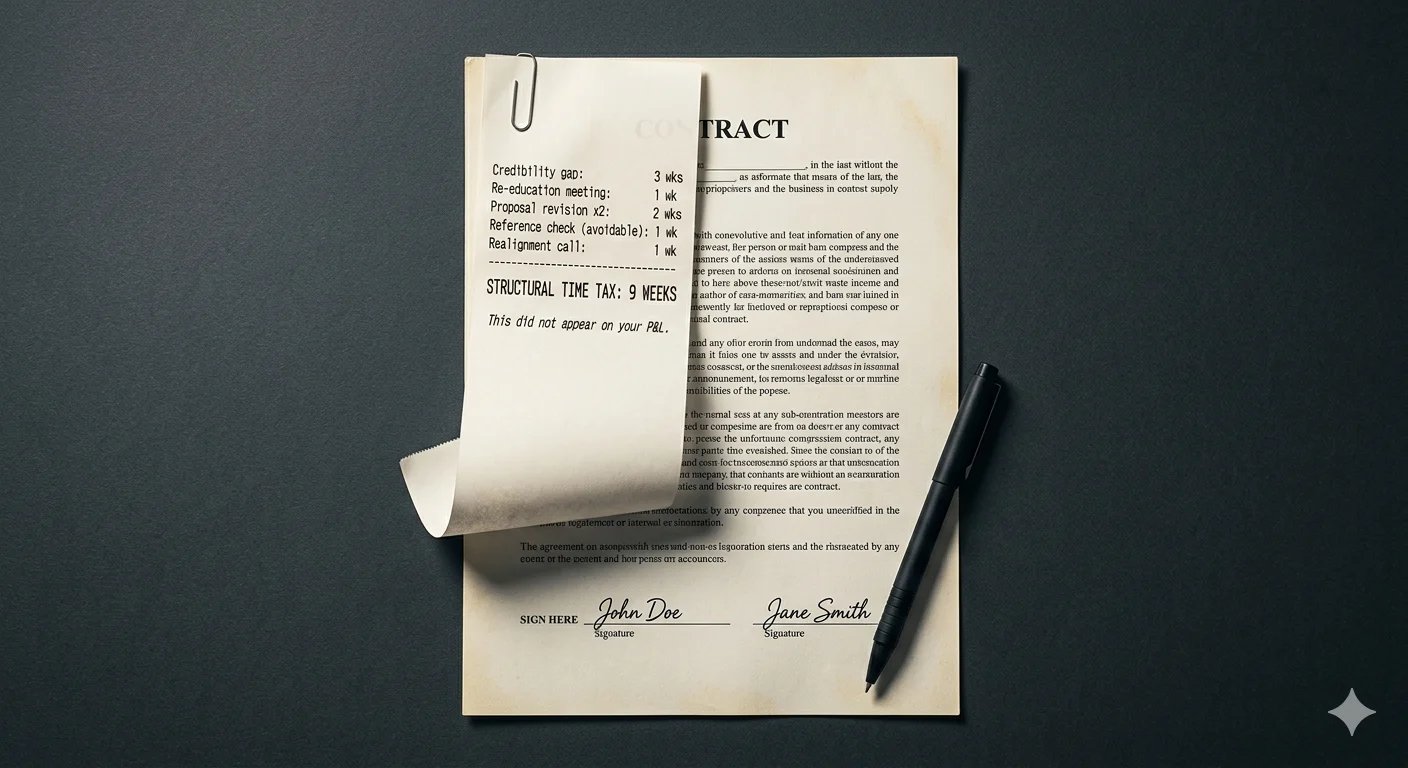

There's a number every founder knows by heart. Average time from first conversation to signed agreement. You track it, report it, occasionally discuss it. You almost never question it.
That's the problem.
The assumption baked into most pipeline reviews is that sales cycle length is a market reality, something shaped by deal complexity, stakeholder count, or the nature of the category. You work with it. You optimize around it. You accept it the way you accept weather.
It isn't a given. It's a measurement. And what it's measuring isn't your market. It's the gap between what your buyers understand when they arrive and what they need to understand before they can say yes. Every week a deal sits in your pipeline, it's closing that gap one conversation at a time, at the most expensive possible moment, with the most expensive possible resource.
That's the tax. Most companies are paying it on every deal they close, without knowing it exists.
The Two Types of Time Inside Every Deal
Not all sales cycle time is the same. Treating it as a single number is exactly why it never moves.
The first type is necessary time: what the buyer genuinely needs regardless of how prepared they are when they arrive. Internal consensus takes time. Procurement processes don't bend. Budget cycles don't care about your close date. A key stakeholder who's traveling isn't back sooner because you followed up again. This time is legitimate, and trying to compress it through pressure or artificial urgency damages trust and kills deals that would have closed on their own.
The second type is structural time: time your deal is consuming not because the buyer needs it, but because a gap was created before they arrived that now has to be closed inside the deal. Time spent establishing basic credibility. Time spent explaining what makes you different. Time spent helping the buyer understand their own problem. Time rebuilding alignment after a proposal reveals that the buyer's mental model shifted between meetings. This time isn't necessary. It's a tax.
The question almost no one asks: when you look at your average sales cycle, how much of it is Type 1 and how much is Type 2? The answer, when founders actually work through it, is almost always uncomfortable, because the structural portion is rarely small, and it's been running on every deal, compounding quietly, for years.
Where the Tax Comes From
Structural time isn't random. It comes from five specific places, each one traceable to something that happened, or didn't, before your first conversation.
The Credibility Gap.
When a buyer arrives without prior exposure to your thinking, the opening conversations aren't really sales conversations. They're auditions. You're establishing that you're worth listening to. When your content has already done that work, first meetings start at a different altitude: discovery moves faster, the buyer asks sharper questions, the conversation is about them rather than about you proving you deserve to be in the room. Research from the Ehrenberg-Bass Institute, replicated across B2B purchase studies, consistently shows that buyers who engage with a vendor's content before initiating contact move through evaluation significantly faster. The credibility work happened before the clock started.
The Problem Alignment Gap.
Most buyers arrive with a surface-level understanding of their problem, the symptom rather than the cause. When that's true, your sales process has to do the reframing work before it can do the solution work. This is some of the most expensive time in any cycle, because it feels like progress. The meeting was good. The buyer seemed to understand. Then the next meeting starts from the same place.
The Differentiation Gap.
When a buyer can't clearly see why you're different, not at the level of claims but at the level of mechanism and proof, they do what any rational person does when they can't tell alternatives apart. They slow down and gather more information. In practice, this gap usually surfaces in a specific moment: the buyer says something like "we're looking at a few options that seem fairly similar, can you help me understand what sets you apart?" That question, asked in meeting three, means the differentiation work wasn't done before meeting one. The next several weeks will be spent answering it, through conversations, through proposals, through reference calls, rather than moving toward a decision.
The Risk Gap.
Complex B2B buyers aren't primarily trying to maximize upside. They're trying to minimize downside: the risk of making a call that looks bad in hindsight, that their colleagues question, or that their organization struggles to execute. When that risk hasn't been reduced before the process starts, the process has to reduce it. The place this becomes most visible isn't in what buyers say to you. It's in what your internal champion reveals when you ask how the conversation went internally. "People are supportive, but they want to understand a bit more about how this has worked for companies like us" is a risk gap. It means the proof your champion needed to build internal confidence wasn't visible before they started selling on your behalf.
The Clarity Gap.
When the scope of what you're proposing isn't clear before the proposal stage, proposals generate questions rather than decisions. Those questions require responses, which require conversations, which require calendar coordination. Multiple rounds of substantive revision, the kind that shift the nature of the engagement rather than refine the details, almost always trace back to a clarity gap that existed before the proposal was written.
Why This Is So Hard to See
Structural time is invisible from inside the process because it looks exactly like necessary time. The deal is moving. The buyer is engaged. There's no obvious signal that you're closing a gap that shouldn't exist versus navigating a step the buyer genuinely needs.
The internal benchmark makes it worse. Most companies measure their cycle against their own historical average. If deals have always taken four months, four months feels normal, even if what's structurally achievable is six weeks.
And the fast deals, the ones that close quickly and cleanly, almost always get attributed to luck. The buyer was ready. The timing was right. The category was easy. What rarely gets examined is why that deal moved, what that buyer had read, heard, or understood before they ever reached out. Those deals aren't lucky. They're proof of what's possible when the upstream work has been done. Every company has a few of them. Almost no one reverse-engineers them.
What a Compressed Cycle Actually Looks Like
Compression is not pressure. When structural time is genuinely removed, deals don't feel rushed. They feel categorically different.
Conversations start at altitude. Discovery is faster because you're confirming fit, not establishing basics. The buyer's questions shift from "help me understand what you do" to "here's our specific situation," and that shift, when it happens in the first meeting instead of the third, changes everything downstream.
Proposals land as confirmations, not introductions. When a buyer arrives already aligned on the problem and the approach, the proposal's job is to document what both parties already know to be true. Reviews are shorter. Feedback is specific. The path to a decision is clear because the decision was essentially made before the document was sent.
Stalls become legible. In a structurally long cycle, stalls are frequent and opaque: something slowed down, but you're not sure what. In a compressed cycle, when a deal stalls, you almost always know why. The champion is waiting on a stakeholder. The budget cycle hasn't turned. The board meeting is in three weeks. Those are necessary delays. You can work with them. The stalls you can't diagnose are the structural ones, and the way to eliminate them is upstream, not in the follow-up.
The Work That Compresses the Cycle
Three categories of upstream investment address the structural gaps directly. None of them happen inside the sales process.
Awareness that builds credibility before the first call. Thought leadership that demonstrates genuine expertise, not general competence, not category familiarity, but a specific point of view on the problems your buyers are navigating. When a buyer has read your content, engaged with your thinking, and arrived with a baseline of trust, the credibility-building work drops almost entirely out of the sales process. First conversations are different conversations.
Problem framing that arrives before the buyer does. Content that addresses the gap between the symptom your buyer names and the root cause you know they're dealing with. Messaging that names the real problem in terms they recognize, not in terms that reflect your solution framework. When buyers have done that reframing before they contact you, your sales process inherits the alignment instead of constructing it.
Risk reduction that happens before trust has to be earned. Case studies written in outcome language, not deliverable language. Evidence that addresses the specific fears your buyer carries before those fears become objections. Proof that's visible early in the buyer journey, not buried in a sales conversation or sent as a late-stage attachment when the deal is already slowing. When buyers arrive with a baseline of confidence, the process can confirm fit rather than build the entire trust foundation from scratch.
How to Audit Your Own Cycle
Start with the last ten closed deals. Map each one by stage duration, not just total cycle length, but where time accumulated. Early accumulation usually points to credibility or problem alignment gaps. Late accumulation points to risk or clarity gaps. Consistent accumulation in the same stage, deal after deal, is a structural signal worth investigating. If it's random across stages, that's a different problem.
Then look at your three fastest deals from the last twelve months. What was different about those buyers when they arrived? Had they been reading your content? Were they referred by someone who had already framed your value for them? The answers almost always reveal what upstream alignment looks like in practice, and point directly at what's creating drag in everything else.
Finally, compare your average cycle length to your fastest legitimate close, a deal where the buyer was aligned, the process was clean, and the close felt natural rather than ground out. The gap between those two numbers is your structural time tax. Calculate how many deals you close in a year, multiply by that gap, and you have a rough measure of the sales capacity your system is currently consuming on work that should have been done before the first conversation started. For most companies running twenty to forty deals annually, the number is arresting. It doesn't appear on any expense report. It shows up in forecast variance, in pipeline anxiety, in the quarterly review where the cycle length gets noted and then accepted as fact.
The Close
The number you've been treating as a fixed reality is a variable. You have more control over it than you've been led to believe.
That doesn't mean you can close everything in two weeks. Necessary time is real. Buyers need space to build internal consensus, navigate their own processes, and make decisions they can defend. Trying to rush that destroys more than it saves.
But structural time is different. It isn't time your buyer needs. It's time your system is generating, through gaps in how buyers arrive, what they understand when they get there, and how much trust they're carrying before you've said a word.
The companies that close fastest aren't the best at selling. They're the best at preparing buyers to buy before the sales conversation ever starts. When that preparation is in place, cycles don't just get shorter. They get calmer. More predictable. Worth winning more consistently.
Your pipeline is telling you something about the health of everything upstream. The question is whether you're reading it, or just reporting it.